Table of Contents
Getting Started with the hashtag.org White Label Suite
Get started with the hashtag.org White Label Suite to rebrand AI agents and portals as your own. White labeling, as LegalClarity outlines, means rebranding an existing product or software and reselling it under your own brand, different from private labeling, which involves custom specifications. It’s legal when contracts spell out labeling, liability, and safety obligations, with federal rules often requiring labels to state “Manufactured for” the actual producer. Both parties share safety-reporting duties and maintain insurance. Software white labeling relies on licensing and support rather than bulk purchase minimums. The hashtag.org White Label Suite extends this model to AI agents and geo-pinned portals. Partners get GIGI agents speaking in their brand’s voice, map-based discoverable portals, and transparent keyword placement without any promise of rankings or traffic. This allows agencies to launch an AI-powered offering without building the underlying technology themselves. Before diving into setup, let’s review what you’ll need to get started.
Key Takeaways
- Preparing for a white-label launch means securing clear contracts, understanding reseller liability, and navigating regulatory obligations, steps that safeguard your brand from the start.
- Your unique #name is the permanent identity that links your geo-pinned portal to your AI agent.
- Establishing a personality is the foundation of client-facing Agentic AI agents and determines how naturally each GIGI assistant represents your brand in conversation.
- Customizing your agent’s search visibility and portal discovery starts from the configuration panels in your dashboard.
- With your agentic SEO configured and your portal discovery live, the next stage connects your lead data to your existing customer relationship platform.
Before You Begin
Preparing for a white-label launch means securing clear contracts, understanding reseller liability, and navigating regulatory obligations, steps that safeguard your brand from the start.
Your white-label agreement should explicitly address intellectual property ownership, indemnification, and your right to rebrand the software. LegalClarity underscores that resellers can face strict liability for defects—simply reselling a service does not transfer product liability away from your business.
Sales tax obligations depend on economic nexus thresholds. In many states, gross sales of $100,000 or 200 transactions trigger a requirement to collect and remit tax. Federal labeling regulations may also require qualifiers like “Manufactured for Your Company” on interfaces or packaging when your brand differs from the original producer; noncompliance exposes you to civil penalties.
Software-based white-label programs (like ours) operate under service-level agreements that define uptime, performance, and support, rather than the Uniform Commercial Code warranties that govern physical goods. This distinction means your obligations and remedies will flow from SLA terms, not from commercial code provisions. We recommend consulting a qualified attorney to review your contracts and confirm compliance with the laws that apply to your region, this content is not legal advice.
Once you have these prerequisites in order, you’re ready to claim your unique #name and activate your portal—the first concrete step in launching your white-label presence.
Step 1: Claim Your #Name and Activate Your Portal
Your unique #name is the permanent identity that links your geo-pinned portal to your AI agent. We make claiming it straightforward so you can activate your portal in just a few seconds.
- Choose a #name that reflects your brand or project—once you claim it, we lock it to your account and display it on your public portal and map pin.
- Confirm your selection and we immediately generate your portal with default settings. You can see it live on the map and begin customizing colors, content, and layout right away.
- Your portal is now active and ready for AI agent configuration.
With your portal live, you can proceed to define your AI agent’s persona and voice so it speaks in your brand’s tone and handles visitor interactions naturally.
Step 2: Define Your AI Agent Persona and Voice
Establishing a personality is the foundation of client-facing Agentic AI agents and determines how naturally each GIGI assistant represents your brand in conversation. A cohesive tone and clear response guidelines keep automated interactions professional, consistent, and aligned with audience expectations.
- Select an overall persona tone—professional, friendly, or authoritative—that mirrors the experience you want leads to associate with your business.
- Upload voice samples so the agent clones your natural speaking style for voice calls and live-response scenarios.
- Provide short video clips to generate a matching face or avatar that personalises on-screen interactions.
- Configure a custom knowledge base that informs every answer with accurate details about your services, policies, and brand story.
Because AI-generated content can drift from intent, review the initial exchanges and adjust the tone or knowledge entries whenever your offering evolves. With your agent’s character set, you can now fine-tune how it is discovered and answers queries in the next step.
Step 3: Customize Your Agentic SEO and Portal Discovery
Customizing your agent’s search visibility and portal discovery starts from the configuration panels in your dashboard. We provide direct access to Agentic SEO settings that let you define the keywords your portal should target for map-based and answer-engine citations.
First, navigate to the Agentic SEO section in your portal’s setup menu. Then, set your location targeting and service radius so your portal appears in relevant local searches. You can also adjust the map pin placement and fine-tune how your portal displays in search results, including the business name and description.
We encourage you to review these visibility settings regularly as your targeting needs evolve. Please note that while the platform offers robust configuration tools, it does not guarantee specific rankings, traffic, or lead volumes. Once you have fine-tuned these settings, you are ready to link your portal with your CRM and lead routing system.
Step 4: Integrate with Your CRM and Lead Routing
With your agentic SEO configured and your portal discovery live, the next stage connects your lead data to your existing customer relationship platform. Open your agency dashboard and navigate to the Integrations panel, where you link your CRM through API key input, webhook URL endpoint configuration, or a native connector for widely used platforms.
For agencies, the whitelabelsuite program provides a dedicated dashboard to manage how to integrate whitelabelsuite for agencies and lead routing from a rebranded interface. After authenticating the connection, define routing rules that assign incoming leads to specific agents, teams, or geographic territories based on criteria such as portal source, inquiry type, or prospect location. This logic runs silently inside our automation layer so every captured contact reaches the right person without manual forwarding.
Once the integration and routing rules are confirmed, the system is ready to activate AI lead generation and begin automated follow-ups for every prospect that enters your pipeline.
Step 5: Set Up AI Lead Generation and Automation
Start by enabling AI lead generation in the dashboard for your chosen portal. This step links our GIGI agent to your map pin and any connected website pages.
Next, train GIGI on your business information. Upload your service descriptions and common FAQs so the agent can answer visitor questions correctly. Define the data points you want to capture (name, phone, inquiry type) and the criteria for escalating a lead to your team.
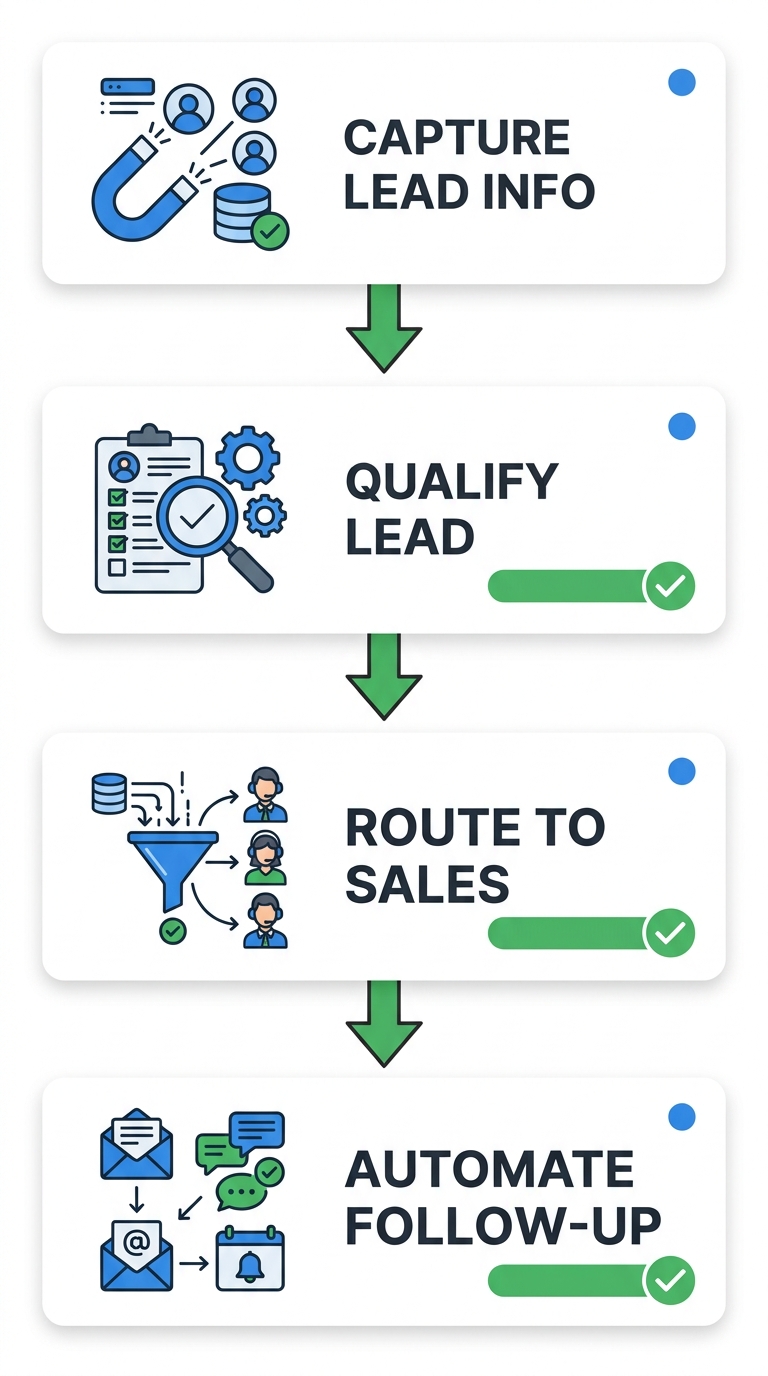
Run a few test conversations to verify GIGI gathers the right details and passes leads to the CRM you integrated earlier. Once your AI agents are reliably capturing and qualifying leads, you can brand the entire experience with your own look and feel using our platform.
Step 6: Brand Your Tools with Whitelabel Customization
White-label customization transforms AI lead-generation tools into a branded experience, allowing you to present chatbots, agents, and portals. Under hashtag.org’s reseller program, we provide the technical infrastructure while you establish the client-facing identity.
A legally sound white-label arrangement must assign intellectual property ownership and grant explicit rebranding rights, as industry legal guidanceemphasizes. According to the same resource, as the reseller you retain full product liability for defects even when a third party supplies the technology. For software-based offerings, service level agreements, not commercial code provisions, define uptime and performance terms.
Guidance highlights that resellers must comply with federal labeling and safety standards, including FTC and FDA requirements, and may need to collect sales tax in states where economic nexus applies. Because these obligations are fact-specific, we always recommend engaging a qualified attorney to review your white-label contracts.
Once the tools are branded and legally secured, you’re ready to deploy them to your clients.
Step 7: Deploy and Launch to Clients
Deploying a white-labeled AI agent begins with generating a unique client-facing portal URL. This custom link serves as the client's digital front door, where the configured AI will interact with visitors.
We recommend these essential steps:
- Generate the client-facing URL. Create a permanent portal link from your reseller dashboard; it will carry the client's identity and hashtag name automatically.
- Configure the client instance. Set the client's business hours, service areas, and contact details so the AI can deliver accurate information from the first interaction.
- Test before launch. Use the sandbox or preview mode to simulate common customer questions and verify that responses, booking flows, and lead capture work correctly.
- Deliver access. Share the portal link with the client and provide a concise onboarding guide explaining how users will engage with the agent.
If any issues surface during launch, the troubleshooting guidance that follows can help you resolve them.
Troubleshooting Common Setup Issues
Legal and compliance considerations often surface as the most pressing issues when agencies and resellers configure a white-label AI agent solution. According to that guidance, resellers must confirm that the white-label contract grants explicit rebranding rights and full intellectual property ownership of the deliverables; ambiguity in these clauses can delay launch and expose the agency to counterclaims.
That guidance also notes that as the reseller, you retain product liability for the service you deliver. We recommend including clear indemnification provisions in your client agreements so that claims arising from the underlying AI platform’s performance are allocated appropriately, rather than landing entirely on your agency.
Service-level agreements with the provider play a pivotal role because software white-labeling is governed by contract law, not the Uniform Commercial Code. These SLAs should address uptime commitments, support response times, and performance benchmarks, so your agency can meet the expectations it sets for end-users.
Tax obligations are another common pitfall. Economic nexus thresholds create sales tax responsibilities even when the provider has no physical presence in a state; That guidance notes that many jurisdictions require collection once a reseller crosses $100,000 in gross sales or 200 transactions within the state. Mapping your clients’ locations early helps avoid compliance gaps.
Clarify the permitted scope of interface customization, knowledge-base personalization, and output attribution so your agency can deliver a cohesive brand experience without unintended intellectual property conflicts.
Resolving these contract, liability, and tax details proactively positions your agency to scale with confidence—opening the door to a fully branded AI front door that feels native to your clients’ businesses.
What types of search and lead intelligence data are available in White Label Suite?
What is White Label Suite and how does it help marketing agencies?
Hashtag.org’s White Label Suite is an agentic AI platform that lets marketing agencies rebrand and resell AI-powered tools—including GIGI agents, geo-pinned portals, and Agentic SEO—under their own brand. It automates lead generation and search visibility while partners maintain direct client relationships and keep up to 50% commission.
Can I rebrand and resell White Label Suite tools as my own service?
Yes. Hashtag.org’s reseller program provides a white-label infrastructure that allows agencies to rebrand AI agents, portals, and SEO tools as their own service. Partners can sell under their domain and identity, with the platform handling back-end delivery.
How does White Label Suite use AI agents to automate lead generation?
The platform uses autonomous agents like GIGI to automate lead generation. You train the agent on your business information, define data points to capture, and set escalation criteria. GIGI then engages visitors, collects lead details, and routes them to your CRM without manual forwarding.
Elevate Your Agency with Your Own AI Front Door
With those setup considerations addressed, you can now confidently move forward to build your own branded AI front door. That guidance confirms that white labeling is legal when robust contracts cover intellectual property ownership and rebranding rights, and our program provides exactly that with SLA-backed support and transparent pricing.
Our white-label infrastructure lets you deliver AI-powered services under your own brand, but it is important to understand the boundaries. The service is provided “as is” and “as available” without warranties. AI-generated content may be inaccurate, incomplete, or outdated; verify before relying on it. We do not provide professional legal, financial, tax, or medical advice; consult a qualified professional. We do not guarantee specific rankings, traffic, visibility, leads, or revenue; outcomes will vary. Crypto and token features carry risk; not investment advice; on-chain transactions may be irreversible. Within these guardrails, we invite you to launch your own AI front door through our partner program.
Launch Your White-Label Agency Today
Now that you've explored all the features and setup steps of this suite, it's time to put them into action. The platform provides everything you need to launch your own branded AI front door, from map-pinned portals that drive local discovery to GIGI agents that speak with your brand's unique voice. By joining the partner program, you can offer these powerful tools to clients while keeping your agency's identity front and center, with full white-label customization and seamless CRM integration. With revenue shares of up to 50% and a clear step-by-step process, scaling your agency becomes a manageable, structured growth path rather than an overwhelming leap. Your next move is simple—enroll as a Partner or Power Partner and start building a white-label AI presence that sets you apart. Your agency's future in the agentic web is ready to begin.
Launch Your White-Label Agency Today