Table of Contents
Using AI to Rewrite Old Tweets for Greater Social Impact
Using AI to rewrite old tweets is the practice of refreshing past posts by rephrasing, updating context, or modernizing language while keeping the original message intact, so that older content can regain relevance without making any guaranteed claims about reach or social impact. It repurposes existing assets to stay visible in feeds without starting from scratch each time.
When a tweet performed well months ago, it will often carry enduring insights that can be surfaced again for audiences who missed it the first time or for a new context. AI tools can rephrase copy, swap outdated references, or adjust tone while you retain control of the original content. The point here is that when used properly, it should still follow X’s rules.
Automating posts on X’s platform must abide by its policy regarding automations. In doing so, users cannot create scripts to post without going through their API. Likewise, AI-powered bots require prior written approval. You’re still responsible for every action your tools take. There will be no guarantees as far as reach/engagement goes.
This process can become tedious if carried out manually. By having a dedicated agent repurpose your content, you'll be able to keep up with refreshing the old posts while preserving the voice that was established and complying with any limitations set forth by Twitter. Your tweet archive will remain current and alive, something that will not be taken away from you.
Key Takeaways
- There is far more involved in turning a past tweet back into relevant content than just selecting new words in place of original language.
- Repurposing content isn't limited to blog posts and videos.
- Our Agentic AI agents include this AI hashtag generator inside the suite that transforms how tweets gain visibility after they have been rewritten.
- Tweeting on your phone no longer has to be done with your fingers.
- An automated tweeting AI allows marketers to schedule and release tweets at optimal times, queuing and publishing them without manually logging in to make each individual post.
Agentic AI Content Repurposer
There is far more involved in turning a past tweet back into relevant content than just selecting new words in place of original language. The Agentic AI Content Repurposer is a machine learning technology that selects, appraises, and reshapes preexisting social media information within other circumstances and contexts without needing to change the content bit by bit through manual human input. Our team has spent over twenty years researching search and creating content, and we see this as a next stage past rephrasing.
A repurser works in a different way: It takes the original source material and changes its format, tone, context, platform, etc., without changing any part of the content that makes the source something worthy of repurposing. The question for the writer might be ‘What can I add’ whereas the question for the agent is 'Where does this idea belong, what kind of form would work on whatever this particular medium needs.'
Autonomous, context-aware decision making replaces surface-level text processing. In this regard, repurpose learns and applies what the original content is trying to convey, which then translates into reusing opportunities wherever possible for each type of platform. As noted above, the process then focuses on how those new contexts call out to content elements: A LinkedIn post must have a particular flavor, a script has its own timing and form requirements, and the world will only allow so much legroom within the body of an e-mail snippet. Repurpose would retain the core brand voice while adapting content for optimal reader engagement based on each channel’s specific ruleset.
One strong tweet can feed many channels at once. The agentic repurposer creates a series of variations on that theme, each tuned for where they will be posted. It doesn't force users to write and rewrite the same message over again for each new platform. Instead, the agent looks at how past repurposing choices have played out and then changes itself accordingly, based only on those patterns in experience.
The following part of the study focuses on applying the described approach in a specific case when GIGI as a persona-driven agent is used to rewrite older tweets keeping a certain voice and purpose.
GIGI Persona-Driven Tweet Rewriter
Repurposing content isn't limited to blog posts and videos. However if you don't lose your own unique flair then doing the same can help keep up your momentum for being consistent about what people get from seeing you post online. Our persona-based GIGI AI agent lets users do this easily.
The agent can train on all of your writing data, past tweets, voice samples, and the custom knowledge-bases you've built into your portal, which means it will be able to learn how you write, what language you prefer and even your hashtag pattern preferences. If you choose to refresh an existing Tweet, GIGI analyses the original voice and generates one or more revised versions, while preserving the overall content and message in the Tweet, but also increasing its clarity and timeliness, or improving its engagement potential.
The agent lets you stay in full control over the final copy. These suggestions serve as guidelines for editing if you want to modify any content before posting it on social media. That doesn’t mean GIGI will publish anything automatically. It won’t unless you’ve configured an auto-posting workflow. This persona-driven approach is what separates GIGI from generic rewriting tools. Unlike some tools, our bot does not simply produce generic writing style without personalizing it based on YOUR individual style, phrasing, hashtags, and personality.
The result is refreshed content that re-engages followers without sacrificing authenticity. AI-generated rewrites should always be reviewed for accuracy, especially if the original tweet included time-sensitive information or personal commitments. Once you have a polished rewrite, pairing it with optimized hashtags can amplify its reach even further—which is our next focus. Claim your #name and let GIGI carry your voice forward.
AI-Powered Hashtag Optimizer
Our Agentic AI agents include this AI hashtag generator inside the suite that transforms how tweets gain visibility after they have been rewritten. It enables people to avoid wasting time attempting to guess which tags might work, because the AI provides intelligent suggestions drawn directly from the content it has already reshaped.
When the optimizer looks at the rewritten Tweet, it takes into account more than just surface level keywords. It tries to understand the overall topic being discussed in the Tweet as well as what is being said about it, looking for commonalities between that information and other conversation happening on the internet right now. It does this through thematic analysis, making sure any suggested tags would be relevant to users reading those conversations, which is why we try to target only tags that fit their audience’s language, talk about topics they’re interested in, etc. This means we will continue to get better at identifying tags that can help make a Tweet easier to find on the internet, without having to do that work ourselves manually.
Manual hashtag selection might also base choices on assumptions about popularity or on hashtags recalled from recent trending subjects. The Optimizer instead focuses on looking into the semantics that aren’t generally spotted in manual hashtag selection. While no tool can predict exact reach, the Optimizer surfaces hashtags that reflect the subtleties of the rewritten message. In this way, the post's potential audience can be broadened more efficiently than research performed by hand.
After choosing hashtags for tweets, they gain yet another channel to be spread throughout - this time as sound via our following AI function.
Voice-to-Text Tweet Converter
Tweeting on your phone no longer has to be done with your fingers. Using hashtag.org's AI voice agent, you can simply speak your tweet out loud and the system will write it down in your tweet box. All you need to do is think up what you want to tweet, and speak that thought out loud, and the machine does the writing part. It doesn't matter if you're tweeting something new, or revising old content. If you speak any revision, then it gets typed onto the screen in front of you. For mobile users, multitaskers, or any user preferring their hands free, this will allow them to catch more ideas as they come up, rather than stopping to type out individual letters. For people who have difficulty physically typing, voice entry could make tweets easier to send. However we don't necessarily recommend relying totally on it in order to post a tweet because sometimes our AI can misunderstand what was said. So please check that your transcription matches up correctly with how you spoke if there is some specific jargon associated with an industry, or you speak with a strong accent. With enough examples provided, we can train the AI voice agent to be better at recognizing your brand's particular language and tone. This voice-to-text converter is part of the agentic AI platform that sits inside your #Portal on the map, which includes agentic AI agents, agentic SEO and agentic sites. When you record a tweet in this manner you will also have AI suggested hashtags added to your tweets to help optimize discovery. If you write up your tweet using voice, once written out you will be able to set its publishing time using our automated scheduling agent. Your spoken ideas will turn into scheduled publications.
Automated Tweet Scheduling AI
An automated tweeting AI allows marketers to schedule and release tweets at optimal times, queuing and publishing them without manually logging in to make each individual post. However, when using this feature, each user must still take full responsibility for any actions executed from his or her account. Before hooking up a scheduling application, it is necessary to familiarize yourself with the current rules around automatic postings, ensuring that your presence remains compliant and consistent.
According to X's official automation policy, you're fully responsible for any actions taken by third-party scheduling applications, even if those actions were unintended or caused by a glitch. This means using AI-powered tweet scheduling software that operates with full transparency.
This policy bans all kinds of automation software that does things that aren't allowed using just the X API. Examples include: scripting interactions, scraping the website, etc. If you're going to be using a scheduling tool at hashtag.org, make sure your tool uses only the official API! Violators may have their accounts permanently suspended for this reason.
An AI scheduler will be able to auto-reply to messages and/or send DMs only if there was a prior written agreement from X in place for them. Otherwise, no message should be sent out as long as the tool is not authorised by X. Even though the tool might schedule when to send out messages according to some triggers, it violates the terms of service unless it has been approved ahead of time. These requirements help protect users from spam and maintain platform integrity.
After tweeting out scheduled posts, the following process entails monitoring how well these posts perform in terms of engagement. Machine learning algorithms can monitor actions such as likes, shares and responses on those posts, offering recommendations that will help make subsequent posts more effective at acquiring audience attention and doing this in compliance with platform regulations.
AI-led Engagement Analytics
Following up on tweets will then be done through our AI-generated analysis. This converts all raw likes, retweets, replies, and views from their initial state into easy-to-understand information that helps you tweak what is wrong in your content plan.
The analytics go deeper than surface numbers. Key metrics we track include engagement rate—total interactions relative to impressions—click-through rate on posted links, and share of voice for your brand’s hashtags. AI compares these signals across your tweet history, surfacing patterns that manual review would miss: which topics spark the most conversation, what posting times earn the highest response, and how sentiment shifts week to week. With this granular view, you can see exactly what content styles resonate with your audience.
With that information in hand, you modify your strategy with confidence rather than guessing. Data-driven choices trump intuition, so you can keep pushing the formats that work well, like threads, questions, polls, and cut back on ones that don't. This evolution feeds itself into a continuous improvement loop: make small tweaks to what works, run the numbers, and continue growing your engagement over time. Your content calendar increasingly looks as if it came out of the mouths of your fans.
Once engagement analytics give you a clear picture of what moves your audience, the next step is letting AI act on that knowledge automatically. Our Trend-Response AI Engine picks up where analytics leave off, using real-time signals to craft timely, on-brand tweets that ride emerging waves. This fusion of analysis and action keeps your brand agile without manual monitoring.
Trend-Response AI Engine
Trend Response AI engine is a core component of our Agentic AI suite that monitors real-time social media conversations on platforms such as X, Facebook & LinkedIn, then drafts contextually relevant responses for human review.
The monitoring layer examines trending subjects, mentions, and tags as they arise, and runs this information via a model including its sector, audience of interest, and previous engagement records. The monitoring layer assigns a score to each pattern's possible engagement according to how your brand has performed historically, so you can invest just your attention for conversations which may make a difference. Only signs that match up with your company's objectives will be sent off towards the generation period. This minimizes noise while increasing the probability of finding significant opportunities.
Then, our generator comes up with many different versions for you, all tailored according to your AI agent's personal character and special training.
- Drafts respect the tone, vocabulary, and stylistic preferences you’ve embedded in your agent’s knowledge base, preserving brand voice.
- You receive a selection of angles — from informative to humorous — so you can choose the response that best fits the mood of the conversation.
- As a practical extension, the engine can identify outdated posts and suggest refreshed content that leverages a current trend, without ever publishing automatically.
Each draft goes to a review queue with context about the trend, allowing your team to review it prior to final approval. Every response draft must be manually approved before going live, so your team retains full editorial control. Once approved, the platform can adapt the response into multiple languages, helping you reach international audiences without losing consistency.
Multilingual Tweet Adapter
Our Multilingual Tweet Adapter takes older, valuable tweets discovered through the Trend-Response AI Engine and repurposes them for audiences who speak different languages. That means old posts can be made new again for local audiences without having to create something entirely new.
In short, when users choose their preferred languages from those flagged up by the engine they have several choices to make. These can range between common tongues, and regional dialects and slang if these exist. In order to produce a rewritten version of the original tweet into various target languages, the adapter will be responsible for analysing its tone, structure, and content. If GIGI has been trained with a certain brand’s personality, this agent will know how to imitate that voice when dealing with its multilingual versions too. Overall, the adapter ensures that messages are adjusted according to place through preservation of the key message, as well as adaptation of phrasing, idiom, and cultural reference in keeping with local tastes. It lives within our agency suite, meaning that it shares the same persona and compliance settings as other agents used at any given time.
All adaptations should be reviewed manually by humans before posting in order to check that they are culturally appropriate and factually accurate. This process makes sure that all translated posts sound natural and are suitable for each market. Automated translation saves time by removing the need to translate posts manually and can convert one post into multiple languages.
When users convert single tweets in multiple languages, it increases the organic reach over geographies as well as maximizes the exposure from content that was known to be engaging earlier. The team can spend more time focusing only on their creative strategies instead of having to translate each message, all the while making sure the voice of the brand remains constant.
After adaptation, the multilingual variants become candidates for split testing in the AI-Enhanced A/B Tweet Tester, helping you pinpoint the top performer for each region.
AI-Enhanced A/B Tweet Tester
Using AI to rewrite old tweets is just one way to refresh your content, but an AI-enhanced A/B tweet tester takes this further by automating the entire cycle of variant creation, live deployment, and performance analysis. We define it as a tool where an AI agent generates multiple tweet versions from a single core message, publishes them to real audiences, and measures which performs best — all at a scale and speed manual testing cannot match.
Instead of writing and scheduling alternatives ourselves, our agents have the AI spit out linguistic alternatives that stay true to its overall message but tweak their hook, CTA, etc. These variants then get pushed out to a real live audience, and we capture metrics like click-through rate or retweet velocity. As the AI is always running, it tests many more variations in less time than if we had done this manually.
Once a statistically significant winner emerges, the AI does not simply declare it; the agent analyzes why that variant outperformed — for instance, a shorter question may have driven more replies — and then iterates on that winning structure to create refined versions for subsequent rounds. This closed loop turns every test into a learning cycle, progressively sharpening message resonance without requiring constant human oversight. We always recommend a brief human review before any AI-generated tweet goes live, keeping brand voice and factual accuracy intact.
Finally, A/B tests that produce these lessons also make way for developing still more varieties of content as you continue down the road toward making sure that what you’re saying on social media feels truly current and relevant to each piece of its target.
AI-Driven Content Variations Generator
After identifying which tweet styles resonate most with your audience, scaling that impact becomes the next priority. The AI-driven content variations generator takes a single tweet and produces several rewritten versions that preserve the core message while offering different tones, lengths, or angles—all without requiring you to draft each variation from scratch.
How the Generator Works
Once you have entered your current tweet, the tool will analyse how well it has been constructed as well as what it wants to say, producing several different options. You may review, edit, or combine these variations before sending out the message. We use NLP to rephrase all the major themes but keep the same core message in mind, so that they sound like different tweets from yourself yet still remain consistent for your brand.
- Flexible tone and style: Choose from professional, casual, humorous, or urgent tones to match the platform or audience you’re targeting.
- Preserved meaning, fresh presentation: Each variation rephrases the language while carrying the same core message, making it suitable for repurposing archived tweets to fill gaps in your posting schedule.
- Streamlined content cadence: By repurposing older tweets instead of writing new ones, you save hours of manual drafting and maintain a consistent publishing rhythm across channels.
This generator can save you a lot of time and energy but will never be a substitute for human judgement. Please take the time to review all generated output before publishing in order to make sure it has the tone of our brand voice, follows platform rules, and expresses what we mean.
If you're focused strictly on getting a rewrite of a tweet under your control, then the way these various different AI systems work are somewhat different than each other. Knowing how they differ can help you decide which option makes most sense for supporting your overall content strategy.
Comparing AI Tweet Repurposing Capabilities
The four main repurposing tools at hashtag.org were pitted against one another as they all adhere to the X Automation Policy.
| Tool Feature | Primary Function | Best For | Pricing Model |
|---|---|---|---|
| GIGI Persona-Driven Rewriter | Rewrites tweets in your brand voice | Agencies and brands | CADE plan ($99/mo) |
| AI-Powered Hashtag Optimizer | Optimizes hashtags for repurposed tweets | Social media managers | BRON plan ($29/mo) |
| Voice-to-Text Converter | Converts spoken ideas to tweet text | Content creators | Annual #name (from $19/yr) |
| Multilingual Adapter | Adapts tweets to multiple languages | Global teams | CADE plan |
| API-Based Automation | All tools use Twitter API; no scripting | Every user | Built-in compliance |
This section covers each individual tool used for the repurposing at various levels, as well as how much each tool costs, with pricing that scales transparently from annual portal ownership to full CADE subscriptions.
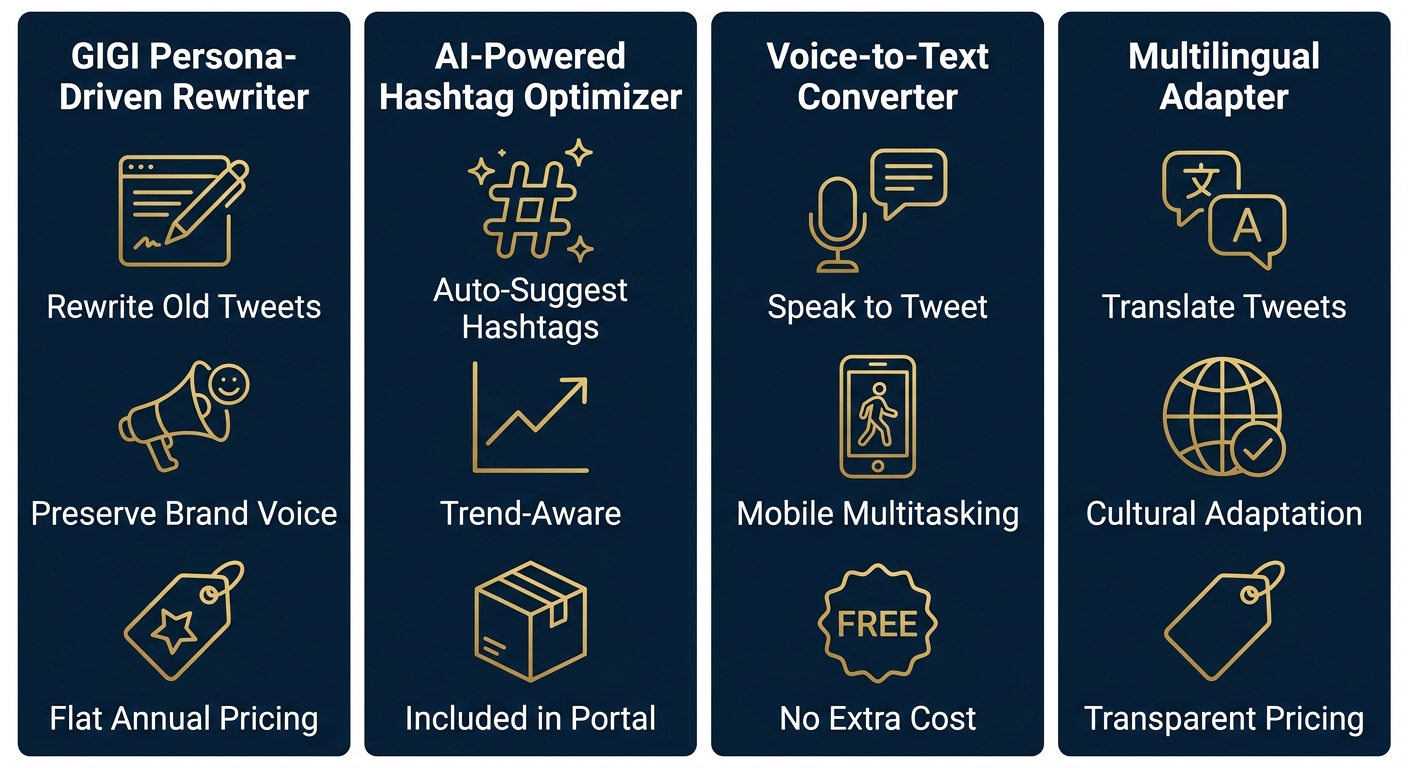
Compare AI repurposing tools for old tweets
X's automation policy holds you accountable for all automated actions and bans non-api scripting. Non-api scriptwriting is not allowed at all. All of the hashtag.org repurposing features rely only upon the approved twitter api. X will also not allow auto reply bot accounts to be made if x has not given its explicit written consent.
By comparing capabilities we can select the right tool and then elevate our overall social strategy with AI-driven tweet repurposing.
FAQ
How can I use AI to repurpose my high-performing old tweets for better engagement?
You can repurpose high-performing old tweets by using an agentic AI content repurposer that reshapes them for new contexts, training a persona-driven agent like GIGI on your writing style to rewrite them authentically, and applying an AI hashtag optimizer to suggest relevant tags for better visibility.
Does using AI to rewrite old tweets help maintain a consistent brand voice across my social channels?
Yes, AI rewriting tools maintain your brand voice by training on your past tweets, voice samples, and custom knowledge-bases. A persona-driven agent like GIGI learns your phrasing, hashtag patterns, and personality to produce rewrites that preserve your authentic style while adapting tone for each social channel.
Why should creators use AI to refresh archived tweet content instead of writing from scratch?
Creators refresh archived tweets with AI to save time by reusing proven insights that audiences missed. An agentic repurposer generates multiple channel-specific variations without manual rewriting, and GIGI can rewrite old tweets while retaining the original message’s strength, making the process more efficient than writing from scratch.
Can AI tools rewrite old tweets to align with current trends while keeping the original message’s core value?
Yes, AI tools can rewrite old tweets to align with current trends while keeping the original message’s core value. The Agentic AI Content Repurposer adapts context and tone without altering essential content, and a Trend-Response AI Engine drafts updates based on real-time conversations, ensuring relevance without sacrificing the core idea.
What are the best practices for using AI-powered marketing platforms to automate the recycling of my social media content?
Best practices include using only API-based scheduling tools that comply with X’s automation policy, obtaining prior written approval for AI-powered auto-replies, reviewing all AI-generated rewrites for accuracy, training your AI agent on your brand voice and knowledge-bases, and using engagement analytics to continuously refine recycled content.
Elevate Your Social Strategy with AI-Driven Tweet Repurposing
It doesn't matter who was involved when using AI to rewrite old tweets, but your own company is responsible for all automations in its account. As soon as you automate something - whether you're doing it yourself or allowing some third-party AI to take action via its software - it falls into the realm of "automated" content, which must comply with X's rules around automation. This policy-first approach ensures your repurposing efforts stay within X's guidelines and protect your brand.
X’s policies prohibit any kind of automation besides its own APIs, like scripting or scraping other pages. You are responsible for all activity on your account. Any process you have where tweets get automatically made out needs to involve only approved methods using their API. AI generated responses require specific written permission from X first. Because AI-generated content can be inaccurate or hallucinated, we also ask you to verify each tweet before it goes live. All services are provided as-is, come with no guarantees around ranking, engagement or revenue, etc… And finally our advice shouldn't replace speaking directly with an attorney about crypto payment functionality because these types of payments often involve additional risks.
Review X’s full automation policy and begin your compliant repurposing workflow now. Use both creative AI rewriting in combination with a policy-first approach if you want to take your social strategy up another notch.
Start Rewriting Tweets Today
You now have a thorough overview of the AI-powered features that can breathe new life into your old tweets, from persona-driven rewriting to automated scheduling. GIGI’s ability to clone your brand voice and suggest optimized hashtags saves hours of manual work. Voice-to-text conversion and multilingual adaptation help you connect with new audiences without starting from scratch. The built-in A/B tester and engagement analytics let you fine-tune each post for better visibility. By combining these tools, you turn a single tweet into a cross-channel content engine. Although no AI tool can promise specific reach, using a data-driven, persona-aware approach consistently can keep your feed fresh and relevant. hashtag.org’s agentic platform brings all of these capabilities together, making it simple to test and implement the strategies covered in this guide. Explore the suite and start rewriting your tweets today.